

The Clearwater Way: Our Three-Part Approach to Lake Management
Learn how Clearwater Consulting, LLC uses biological control, mechanical aeration support, and hands-on monthly management to keep Texas private lakes visually pristine and ecologically healthy year after year.
Our goal as a lake management company is twofold: to maintain a healthy visual condition of the pond for all employees, residents, and visitors, and — more importantly — to maintain the long-term health of the pond's underlying ecosystem. The two go hand in hand.
A visually pristine lake is almost always the surface-level signal of an ecosystem that is working the way it is supposed to, and conversely, a lake that is biologically out of balance will eventually show it on the surface no matter how much reactive treatment is thrown at it. For that reason, our philosophy is to invest in the biological and mechanical foundations that keep a pond self-regulating, and then apply targeted treatment on top of that foundation rather than in place of it.
We take a three-part approach to get there — a combination of biological control, mechanical support, and hands-on management — each of which does something the other two cannot.
Biological Control
Tilapia Stocking
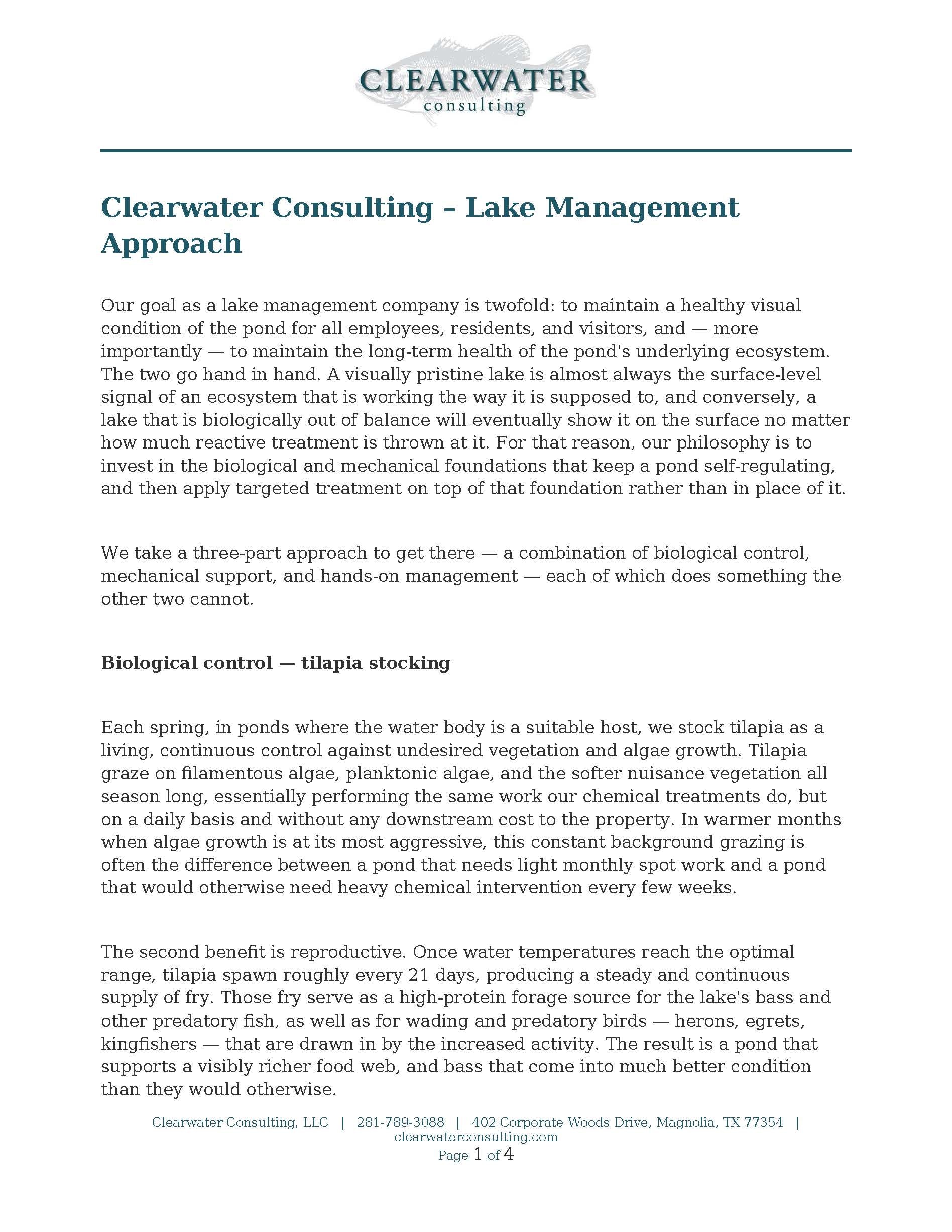
Each spring, in ponds where the water body is a suitable host, we stock tilapia as a living, continuous control against undesired vegetation and algae growth. Tilapia graze on filamentous algae, planktonic algae, and the softer nuisance vegetation all season long, essentially performing the same work our chemical treatments do, but on a daily basis and without any downstream cost to the property.
In warmer months when algae growth is at its most aggressive, this constant background grazing is often the difference between a pond that needs light monthly spot work and a pond that would otherwise need heavy chemical intervention every few weeks.
The second benefit is reproductive. Once water temperatures reach the optimal range, tilapia spawn roughly every 21 days, producing a steady and continuous supply of fry. Those fry serve as a high-protein forage source for the lake's bass and other predatory fish, as well as for wading and predatory birds — herons, egrets, kingfishers — that are drawn in by the increased activity. The result is a pond that supports a visibly richer food web, and bass that come into much better condition than they would otherwise.
Where tilapia programs have been in place for multiple years, we routinely see a dramatic reduction in the amount of chemical treatment a pond requires to stay in good condition. One of our longest-running tilapia programs has seen a night-and-day difference in overall lake health compared to the years before the program was in place.
Because tilapia are tropical, they die off every winter during Texas freezes. This is fully expected and factored into our planning. The die-off does release some nutrients back into the water column, which can contribute to a mild early-spring algae bloom; we manage that with targeted treatment until the new tilapia population restocks and establishes.
Mechanical Support
Aeration Systems
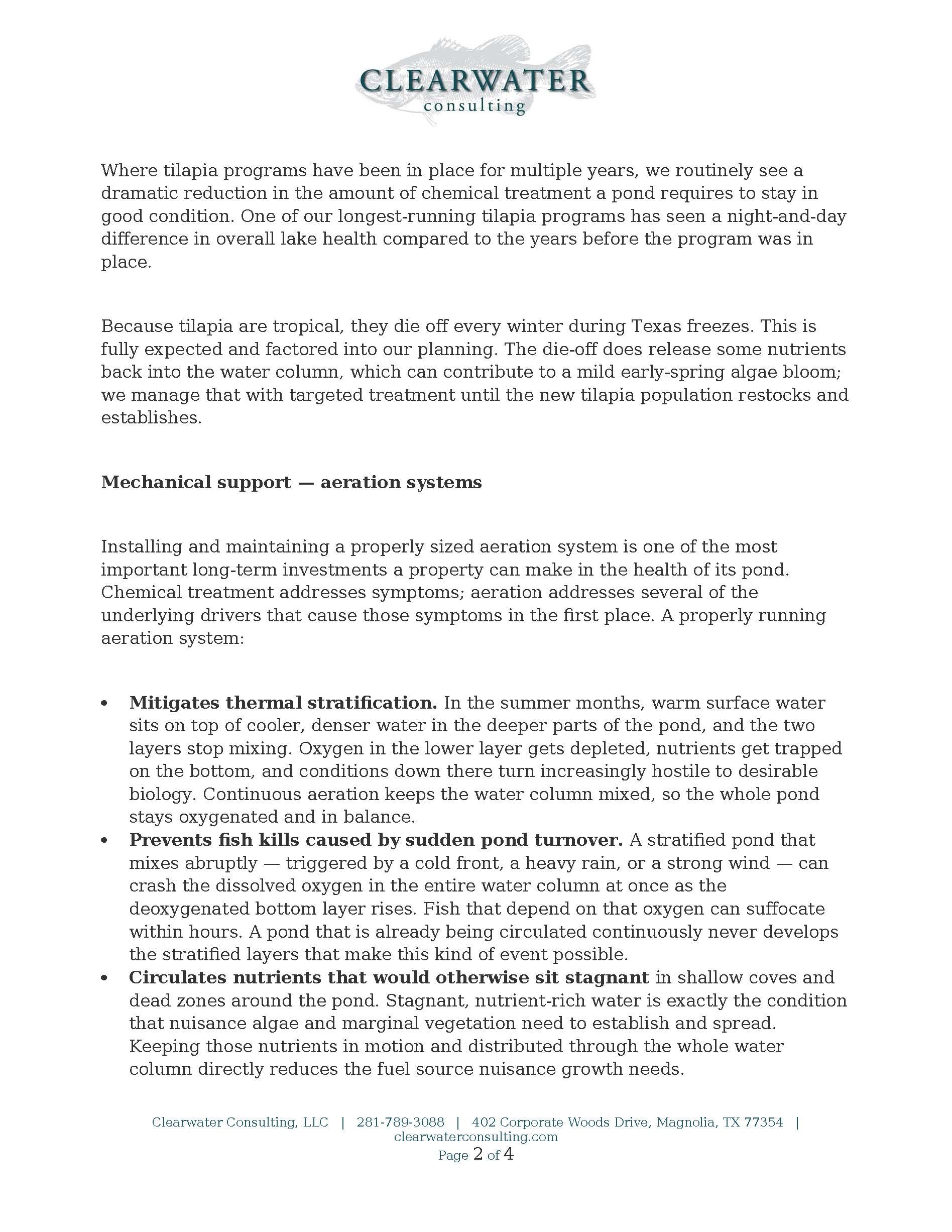
Installing and maintaining a properly sized aeration system is one of the most important long-term investments a property can make in the health of its pond. Chemical treatment addresses symptoms; aeration addresses several of the underlying drivers that cause those symptoms in the first place.
A properly running aeration system:
Mitigates thermal stratification. In the summer months, warm surface water sits on top of cooler, denser water in the deeper parts of the pond, and the two layers stop mixing. Oxygen in the lower layer gets depleted, nutrients get trapped on the bottom, and conditions down there turn increasingly hostile to desirable biology. Continuous aeration keeps the water column mixed, so the whole pond stays oxygenated and in balance.
Prevents fish kills caused by sudden pond turnover. A stratified pond that mixes abruptly — triggered by a cold front, a heavy rain, or a strong wind — can crash the dissolved oxygen in the entire water column at once as the deoxygenated bottom layer rises. Fish that depend on that oxygen can suffocate within hours. A pond that is already being circulated continuously never develops the stratified layers that make this kind of event possible.
Circulates nutrients that would otherwise sit stagnant in shallow coves and dead zones around the pond. Stagnant, nutrient-rich water is exactly the condition that nuisance algae and marginal vegetation need to establish and spread. Keeping those nutrients in motion and distributed through the whole water column directly reduces the fuel source nuisance growth needs.
Supports the aerobic bacteria that live on the pond bottom and break down organic muck — fallen leaves, decaying vegetation, uneaten feed, fish waste. When oxygen is available down there, those bacteria work continuously to break the sediment load back into its component nutrients and water. When it is not, that muck accumulates year after year, raising the overall nutrient load of the pond and making every subsequent management visit harder.
Improves overall fisheries health by maintaining dissolved oxygen levels fish actually need to feed, grow, and reproduce.
When aeration is working as designed, it is doing ecological work no amount of chemical treatment can replace. Our visits to a pond with healthy, continuously-run aeration consistently require less product, achieve better results, and leave the pond in a condition that holds for weeks longer. By contrast, a pond with an aeration system that sits idle for extended periods will often require more frequent treatment just to maintain a baseline visual condition, because the underlying driver of the problem is never addressed.
Hands-on Care
Regular Management Visits
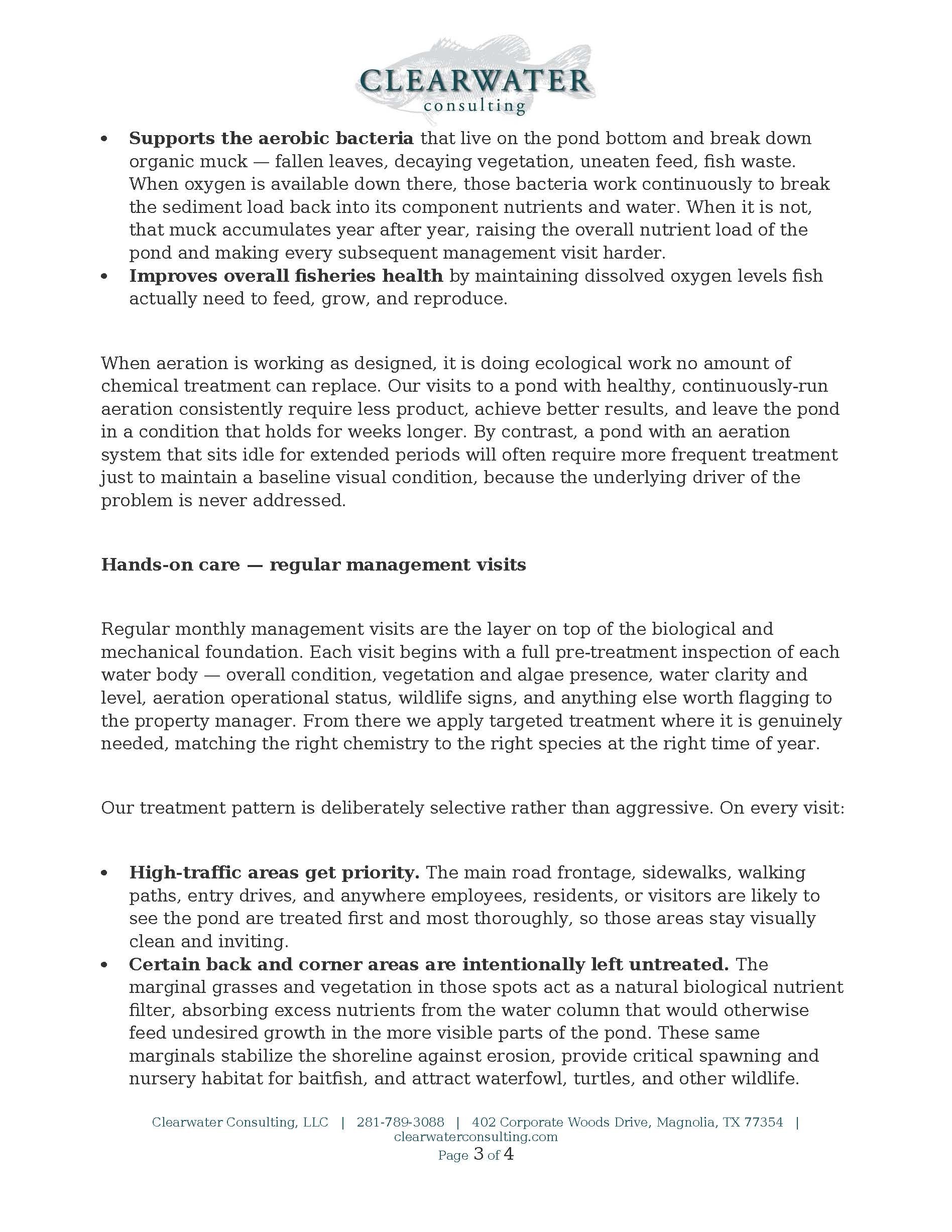
Regular monthly management visits are the layer on top of the biological and mechanical foundation. Each visit begins with a full pre-treatment inspection of each water body — overall condition, vegetation and algae presence, water clarity and level, aeration operational status, wildlife signs, and anything else worth flagging to the property manager. From there we apply targeted treatment where it is genuinely needed, matching the right chemistry to the right species at the right time of year.
Our treatment pattern is deliberately selective rather than aggressive. On every visit:
High-traffic areas get priority. The main road frontage, sidewalks, walking paths, entry drives, and anywhere employees, residents, or visitors are likely to see the pond are treated first and most thoroughly, so those areas stay visually clean and inviting.
Certain back and corner areas are intentionally left untreated. The marginal grasses and vegetation in those spots act as a natural biological nutrient filter, absorbing excess nutrients from the water column that would otherwise feed undesired growth in the more visible parts of the pond. These same marginals stabilize the shoreline against erosion, provide critical spawning and nursery habitat for baitfish, and attract waterfowl, turtles, and other wildlife. Running a pond free of all marginal vegetation would eliminate most of what makes the pond function as a healthy habitat in the first place.
Wind, rain, and water-level conditions are factored in. Wind direction and velocity routinely limit how far spray can reach from the bank on any given visit, and we work with the conditions rather than fighting them. When a stubborn stand of alligator weed or an algae mat rebounds the following month, that is usually a normal part of getting it under long-term control — these are tough, mat-forming plants with aggressive root systems, and a well-timed follow-up treatment is often how the job is actually finished.
Boat treatments are deployed when they are needed. On larger ponds, we periodically launch a spray boat to reach the full shoreline from the inside, catching areas that cannot be effectively treated from the bank. This is a seasonal rhythm, not a per-visit activity, and we schedule it to catch marginal vegetation and algae before summer peak growth takes hold.
Each visit is paired with a written report back to the property manager, so there is a continuous paper record of what was treated, what was observed, what is trending, and what the plan is for the next visit. This also gives property management something to point to when they need to show their stakeholders the care that is going into the lake.
The Outcome
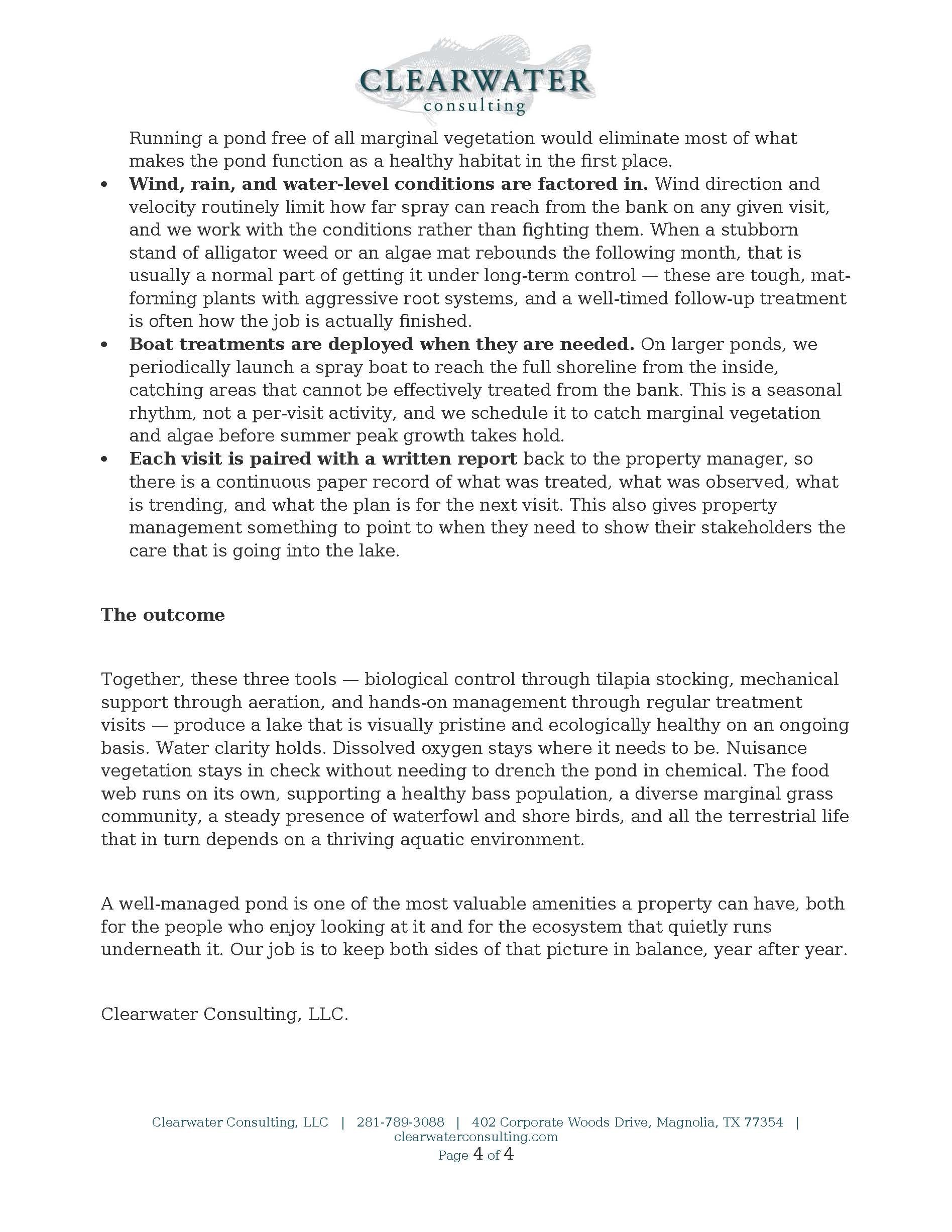
Together, these three tools — biological control through tilapia stocking, mechanical support through aeration, and hands-on management through regular treatment visits — produce a lake that is visually pristine and ecologically healthy on an ongoing basis. Water clarity holds. Dissolved oxygen stays where it needs to be. Nuisance vegetation stays in check without needing to drench the pond in chemical. The food web runs on its own, supporting a healthy bass population, a diverse marginal grass community, a steady presence of waterfowl and shore birds, and all the terrestrial life that in turn depends on a thriving aquatic environment.
A well-managed pond is one of the most valuable amenities a property can have, both for the people who enjoy looking at it and for the ecosystem that quietly runs underneath it. Our job is to keep both sides of that picture in balance, year after year.
— Clearwater Consulting, LLC
Ready to Put This Approach to Work on Your Lake?
Our biologists serve HOAs, golf courses, ranches, and corporate campuses across Texas. Reach out and we'll start with a free assessment of your water body.